


This website uses cookies to improve your experience. We'll assume you're ok with this, but you can opt-out if you wish. Read More

August 11, 2026
Learn how two prisoners communicated by tapping on a wall and the book that saved one of them
The week’s story is about how two prisoners in solitary confinement learnt how to communicate to each other by tapping on a wall and how the reading a book saved one of them from despair.
In 1981, Mohammed Barud, newlywed, wrote a pamphlet about conditions and resources at the local hospital. He distributed five copies of the pamphlet to his friends and soon after was advised to recoup the pamphlets and destroy them.
Somalia was ruled by a military dictator, Siad Barre who took swift and brutal action against anyone critical of him or the state.
3.00 am and Barud and his young wife, Ismahan, are woken by pounding on the door. Three armed state police officers have come to take Mohammed to their offices, and they tell his wife that he’ll be back within the hour.
Barud was tried for treason and alongside him in the dock was a doctor from the hospital, Dr Anan Abokor, who had written a critical letter about the lack of supplies. Both were sentenced to execution by firing squad.
Outside the court room there was a protest that soon became violent about the trial of Dr Abokor and fearing more widespread civil unrest, the sentences were commuted to life in solitary confinement.
The prison cell was two metres squared and infested by insects and rodents. It was a long distance from their hometown and neither was allowed any visitors. Barud spiralled into a depression as he imagined his wife would abandon him. Prisoners’ wives were encouraged to divorce their husbands – a process made simple if they hadn’t seen them after a certain period.
Communication with other prisoners was non-existent, until Barud heard a whisper from the next-door cell.
“Learn ABC through the wall”
Then he heard some knocking and knew it was a code – a certain knock for the letter A, another for B and so on.
His next-door neighbour was Dr Abokur and over the following months using knocking on the wall, he tried to ease Barud’s mental anguish. As a doctor, he knew it was his duty to ease the suffering of another.
Two years into their sentence, Dr Abokor was called to the Governor’s office. When he had started his sentence, his books were confiscated, now he was allowed to choose one book to take back to his cell.
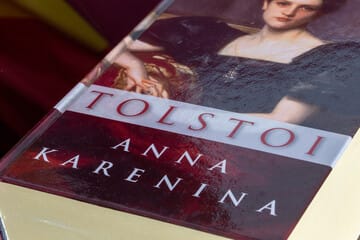
He chose Anna Karenina by Leo Tolstoy.
Back in his cell, his knocking told Baruk that he was going to read Anna Karenina. He thought it might distract his friend from his suicidal thoughts.
Just think about this for a moment. The book is over 800 pages, about 350,000 words and nearly 2 million letters, all to be told by knocking on the wall.
Many of you probably know the story of Anna Karenina. She was a married member of the Russian nobility with a young child. She falls madly in love with Count Vronsky and leaves her husband and child causing her to be ostracised. Rather like, Barud, she becomes obsessed by what Vronsky may be doing as she’s left alone at home. Eventually, she’s driven to suicide.
It took Dr Abokor about a year to tell the story to Barud. The knocking became sophisticated as Barud with a simple knock would tell Dr Abokor to move on to the next word.
To begin with Barud associated himself with Anna’s anguish but then realised it was more applicable to his wife. Although she was free, perhaps she was suffering because of the imprisonment of her husband.
After eight years, suddenly Barud and Dr Abokor were freed and bizarrely driven to see President Siad Barre. The president told them that the country was in political upheaval and undergoing civil unrest. Their release would signify a change in political attitude.
He gave them a bag full of money and when they went to pay for a coffee in a local café, the owner told them, they still owed him money so rampant was inflation!
Barud started a search for his wife and eventually was told by his brother that she had fled Somalia and was now living in Germany. Barud traced her to a refugee camp and when they heard each other’s voices for the first time in eight years, they burst into tears. She had fled Somalia because she resisted the pressure to divorce but had no papers to return.
As Barud mentions in his book The Mourning Tree when they were reunited a year later, they had to rekindle their relationship as so much had happened to them during the nine years spent apart.
Barud and Dr Abokor set up an organisation dealing with Somaliland human rights. He lives with his wife in their hometown, Hargeisa, where they had first fallen in love. The man who saved him, Dr Abokor, died of Covid in 2020.
If you’ve heard of an inspiring story do let us know at editorial@silverskys.com
You need to sign up or be logged in to leave a comment.